
I bought the so-called “five-part trilogy” of The Hitchhiker’s Guide to the Galaxy ages ago and let it gather dust until last year. Finally, I cracked open the first book… and wow, Douglas Adams does not disappoint! Honestly, even the phrase “five-part trilogy” is such an Adams move-dry, sharp, and hilarious from the get-go.
This book is not about where the plot’s going. It’s more like Douglas Adams gleefully reminding everyone that “plot” is optional if you’ve got enough ridiculousness, cosmic confusion, and dry wit to fill in the blanks. This little corner of the blog is just about the first book. Trying to cover everything would probably break my brain.
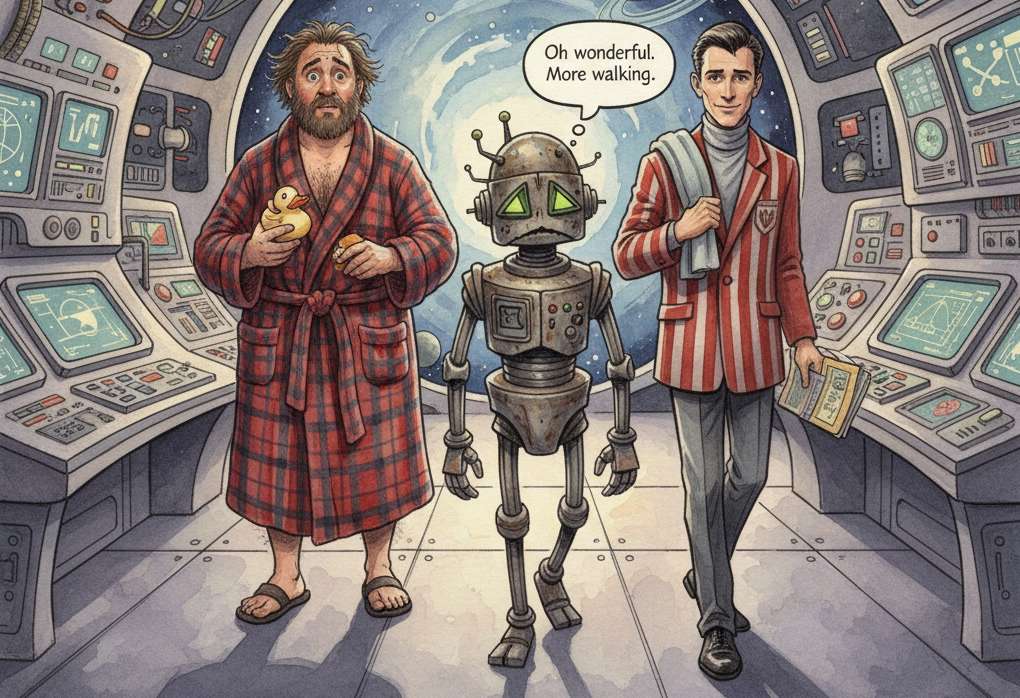
So, what hooked me the most if not the plot? The analogies. Like the famous improbability drive-supposedly a wild sci-fi idea, but a huge wink at how random, weird, and completely inexplicability real life (and, I guess, the entire universe). Even that eternally depressed robot, Marvin, feels like a parody of the modern “nothing matters and I’m slightly bored with everything” vibe I get from half my for you page. Maybe I overthink these things but it this overthinking that kept me turning the pages-and yeah, the epic deadpan humour.
Poor Arthur Dent loses his house… and, five minutes later, the planet-just so a galactic bypass can go through. All because of paperwork, which is so on-the-nose it almost hurts. Supposedly, some “planning documents” were available for viewing-if you happened to be on Alpha Centauri, which is a throwback to every time anyone’s been steamrolled by some random decision “for the greater good.” Oh, and the kicker? The bypass never even happened. Bureaucracy at its finest.
The book is also basically a roast of anyone who wants power. Adams just drags the whole “The President really doesn’t do anything” routine, making it clear all the real action happens offstage, far away from the clueless figurehead. There are little stabs at left-wing union drama and right-wing greed, but mostly Adams is waving a flag for anyone who’s ever thought, “Wait, do these people actually know what they’re doing?” Spoiler: answer is usually no.
When Earth explodes, characters basically shrug and keep going. That, apparently, is the official Guide-approved existential coping mechanism. “Don’t Panic,” says the book’s cover (and everyone who’s ever tried to survive a workday), and that’s more or less how Adams sees surviving the universe’s wildest curves.

Adams also pokes fun at the whole “tech will fix everything” myth. In this world, you can have talking doors, depressed robots, and spaceships that look like running shoes, but everyone is still caught up in bureaucracy or private little crises. Fancy gadgets don’t make anyone actually happier or less neurotic-if anything, they’re just stressed in more creative ways.
Relatable anxiety is all over the place, mostly in Arthur. Even after the world ends, he just wants a cup of tea. That’s the hill he’s ready to die on, exceptional. The other main characters are equally bonkers. Ford Prefect is clever but unsympathetic because, hey, alien life. Zaphod Beeblebrox is all ego with a tiny sprinkle of good intent. Marvin is so depressed it’s actually funny and sometimes uncomfortably real. And Trillian is smart and thoughtful (wish Adams gave her even more to do, honestly).
The best part? All the characters, even when they’re complete caricatures, still manage to feel legitimately relatable-freakouts, blackouts, dry humor, and all. Every page is a reminder that life in the universe is weird, random, and maybe best survived when not taken too seriously (and, if possible, while sipping a nice cup of tea).
Leave a Reply